EFFECT OF SILVAMIX® FERTILISERS ON THE MYCORRHISE DEVELOPMENT IN FOREST NURSERIES
There is a method that enables to meet two, relatively opposite objectives under practical conditions of forest nurseries, viz. to assure a rich development of mycorrhise on roots of transplants and to apply industrial fertilisers enabling a vigorous growth of young plants. This opportunity provide the so-called slow-release fertilisers.
The importance of mycorrhise in forestry is based on two principal functions that this type of symbiosis fulfils. Firstly, it enlarges the absorption surface of roots for water and nutrients and secondly it protects the root system of plants against pathogens. In all forest woody species the uptake of mineral nutrients, and especially of phosphorus, dependent the development mycorrhise that is an integral part of a properly functioning root system.
New, nature-friendly and ecological methods of forest management are focused, among others, onto the care about the development of mycorrhise and its revitalisation in soils of older forest nurseries. A high vitality of transplants after their transfer on the permanent site is dependent on the amount and quality (i. e. species spectrum) of mycorrhise developing on roots of transplants in the period of their cultivation in forest nurseries. This is the actual base of the modern approach to the nursery production that supplies the planting stock for forest regeneration and afforestation.
This means that it is necessary not only to produce seedlings and transplants with an adequate size of tops and a proper architectonics of the root system but also with a rich and stratified mycorrhise. Under practical conditions these two objectives are sometimes hardly compatible because an intensive fertilisation (and above all the supply of nitrogen) that guarantees a perfect growth and habitus of aboveground parts of transplants often results in a significant inhibition of mycorrhise, especially in coniferous species.
In general, a too intensive fertilisation causes a narrowing of the spectrum of mycorrhitic fungi to only one or two symbionts adapted to specific conditions of a given nursery and in extreme cases it can even result in a complete absence of mycorrhise formation and development. On the one hand, application of low doses of industrial fertilisers in forest nurseries can contribute to a spontaneous, rich and natural, but as compared with the natural situation, rather different mycorrhise. However the final effect of such a measure is that the quality of transplants is low and that the produced nursery stock does not satisfy expectations of nursery and forest managers. On the other hand, there is a method enabling to meet both these requirements, i. e. to assure a rich development of mycorrhise on roots of seedlings under conditions of application of industrial fertilisers supporting a proper growth and development of young transplants.
This method is based on application of the so-called slow-release fertilisers. One of the best-known products of this type is a pelleted fertiliser supplied to the market under the trade mark Osmocote® and used in Europe for many years mainly in nurseries producing ornamental trees and shrubs. Unfortunately, it is too expensive for application in forest nurseries. Recently, new and cheaper slow-release fertilisers of the SILVAMIX® series appeared on our market.
This Czech product is a full, chloride-free fertiliser with a high content of mineral nutrients. SILVAMIX® fertilisers are able to release minerals for a long (2 - 3 years) period after their application. The major nutrient of this product is nitrogen in a non-ionised form of ureaform condensate that can be released very slowly into the soil. This means that, as compared with easily soluble conventional fertilisers, SILVAMIX® fertilisers do not cause an undesirable (and for the development of mycorrhise also inhibiting) concentration of nitrogen in soil shortly after the fertilisation.
From the physiological point of view the fertilisers of the SILVAMIX® series can be classified as slightly alkalic products that show a positive effect on fertility of especially acid and very acid soils that are very frequent in our forest nurseries. These properties of SILVAMIX® fertilisers as well as an offer of the manufacturer (ECOLAB Znojmo, s. r. o., Ćzech Republic) and a possibility to test free of charge samples of this product in a loose form (powder and/or grit) moved us in 1998 to the establishment of a series of experiments the objective of which was to test the effect of powdered SILVAMIX? fertilisers on the development of mycorrhise under conditions of forest nurseries.
Experiments were performed with two-year and one-year-old seedlings of Scotch pine (Pinus silvestris L.). In (2/0) trees the fertiliser was used as a supplementary source of nutrients while in (1/0) transplants it was applied into the substrate prior to planting. Seedlings were planted in the spring of 1999 and remained on the site also in the next year because we wanted to study the subsequent effects of this fertiliser. The experimental scheme of both tests was as follows: 1. Control with N P K Mg (ammonium saltpetre, superphosphate, kalium sulphate, and kieserite in the same amounts as in SILVAMIX® R) 2. SILVAMIX® (with 10.3%; 16.4%; 6.3%; and 5.0% of N; P; K; and Mg, respectively) 3. SILVAMIX® MG 4. SILVAMIX® FORTE 5. SILVAMIX® R
Fertilisers were applied according to their contents of nitrogen in the dose corresponding with 75 kg N/ha. Doses of P,K, and Mg were graded, i. e. higher in case of SILVAMIX® MG and lower in the variant with SILVAMIX® FORTE and nearly the same for all other fertilisers with the content of nitrogen about 10 %. The care about seedlings and silvicultural procedures were the same as in the control variant.
The application of conventional (easily soluble) fertilisers resulted in a greater promotion of growth of tops than in case of SILVAMIX® products (this tendency was obvious but statistically non-significant). However, there were considerable differences in the development of the root system of experimental seedlings, especially as far as the numbers of fine roots (with the diameter below 1 mm) were concerned because they were much better developed than in controls fertilised with conventional (NPK Mg) fertilisers. This showed a direct effect on the development of mycorrhise (Fig. 1).
In variants with SILVAMIX® fertilisers a marked dominance of ectomycorrhises was observed and the occurrence of less favourable (for young transplants) endomycorrhises (Fig. 2 ; Photo 1 A and B).
Besides, fertilisers of the SILVAMIX® series enabled also the development of more differentiated ectomycorrhises than convention all ones (Fig. 3; Photo 1 C-F).
As far as the effect on the diversity of species was concerned, the product SILVAMIX® FORTE gave the best results.
CONCLUSIONS
When evaluating all data obtained in this experiment it is possible to conclude that the fertilisers of SILVAMIX® series showed a very positive effect on the development of mycorrhise in tested seedlings of Scotch pine and that they were much better than the conventional products.
Fig. 1: Effect of SILVAMIX® fertilizers on the development of the fine roots (<1 mm) length (cm) and the number of mycorrhizes arisen in biennial Scotch pine (2/U)
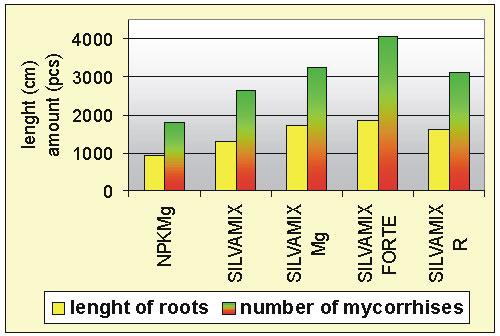
Fig. 2: Effect of SILVAMIX® fertilizers on the occurrence (%) of endo- and ectomycorrhizes in biennial Scotch pine (2/U)
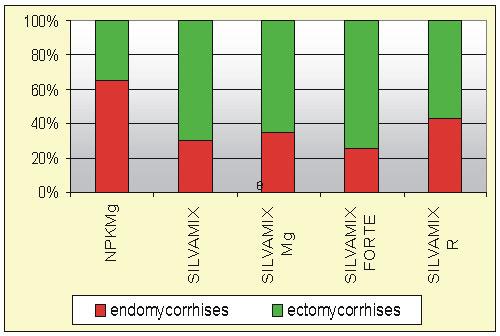
Fig. 3: Effect of SILVAMIX®FORTE fertilizer on the spectrum variety and occurrence (%) of ectomycorrhizes in biennial Scotch pine (2/U)
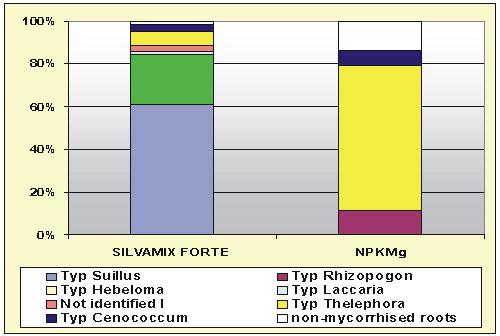
Photo 1 - 6
Micorrhizal fungi growing on the root seedlings of Scotch pine (A-B endomycorrhizes; C-F ectomycorrhizes)
 |
 |
 |
||
| A | B | C |
 |
 |
 |
||
| D | E | F |


Many advantages and benefits for your plants